Industrial Firefighter vs Municipal Firefighter Jobs: How Do They Compare?
 Written By: Jeff Kirschner, General Manager
 Written By: Jeff Kirschner, General Manager
Industrial and municipal firefighters share many of the same core skills, but the jobs themselves are structured quite differently. An industrial firefighter protects a specific facility or job site for a private employer, while a municipal firefighter serves an entire jurisdiction through local government. From training and certifications to pay, schedules, and day-to-day responsibilities, there are several key differences between the two career paths.
While both industrial and municipal firefighters share the same core job of protecting people and property from fire, their employers, responsibilities, scope of response, and training requirements differ.
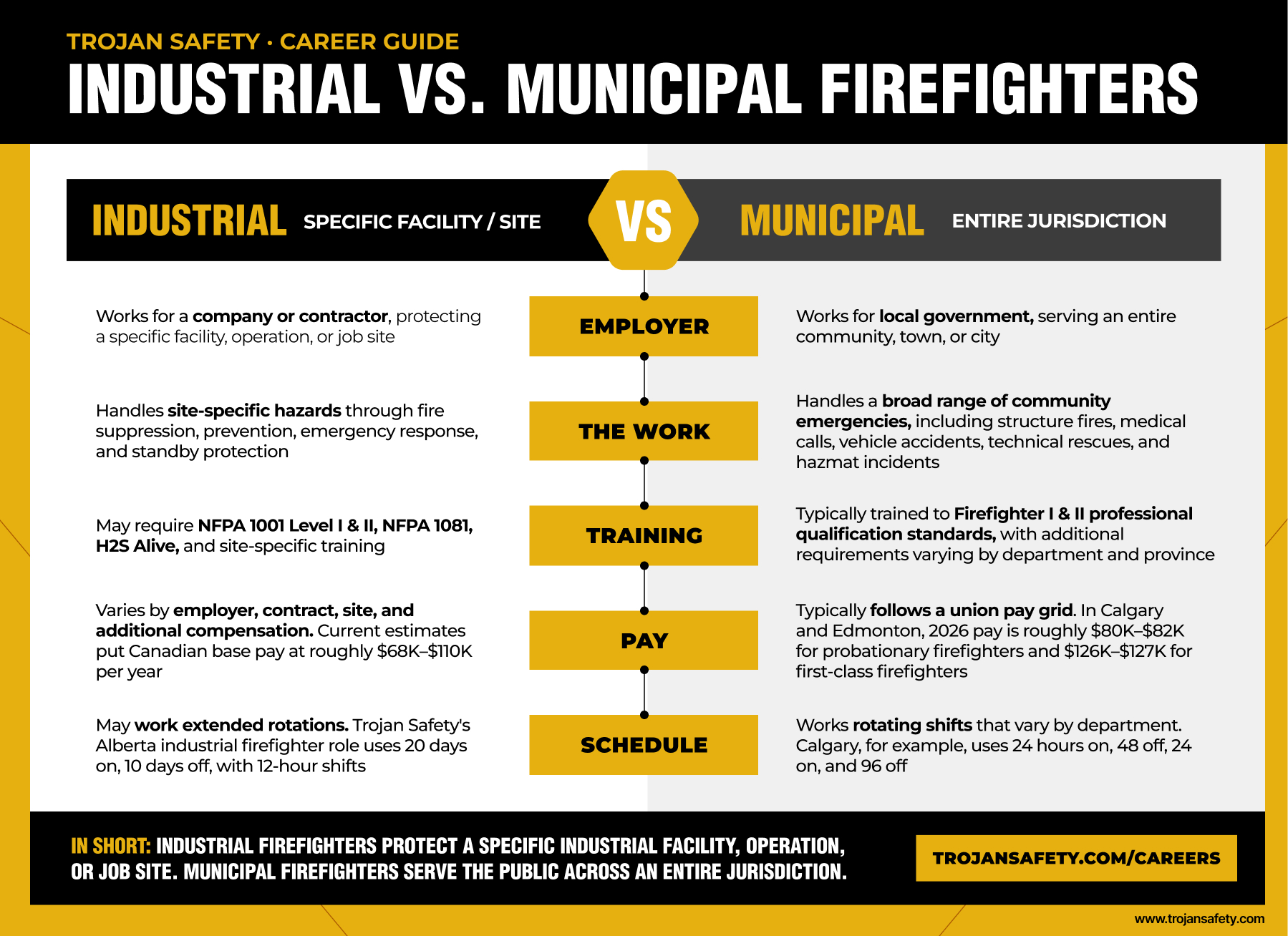
Industrial firefighters work for a company, such as Trojan Safety, and protect a specific facility, such as a refinery, chemical plant, or oilfield operation. Their training and equipment are tailored to the site’s hazards, with response duties generally limited to the property and focused on protecting the facility, its equipment, and the people working there.
Municipal firefighters are public employees working for a local government. They respond to emergencies throughout their department’s jurisdiction, covering homes, businesses, and public infrastructure while protecting people and property across the community.
In short, industrial firefighters protect a specific industrial facility, operation, or job site, while municipal firefighters serve the public across an entire jurisdiction.
The industrial firefighter role can also look different from one site to another. NFPA 600 sets requirements for facility fire brigades, but the level of response a brigade is equipped and trained to provide depends on its assigned duties and the hazards present at the facility.
Both industrial and municipal firefighting roles share the same firefighting fundamentals, but their day-to-day responsibilities are shaped by where they work. Industrial firefighters focus on site-specific hazards and worker safety, while municipal firefighters respond to a wider range of emergencies throughout their communities.
The main difference between industrial and municipal firefighter responsibilities is the range of hazards and incidents each role is expected to handle. Industrial firefighters develop specialized knowledge of the risks, equipment, and emergency procedures specific to a facility, while municipal firefighters must be prepared to respond to a variety of incidents throughout their jurisdiction.
Industrial and municipal firefighters may follow different training and certification pathways, but both require candidates to meet established standards for the role. Understanding where these requirements overlap and where they differ can help clarify what each career path involves.
Industrial and municipal firefighting positions have similar qualifications, including education, physical fitness, and the ability to meet the demands of emergency response. The specific qualifications and hiring standards depend on the employer, department, and province.
Trojan Safety’s Alberta industrial firefighter role requires candidates to maintain a reasonable level of fitness, have normal colour vision for colour-coded safety systems, and be able to work consecutive 12-hour day and night shifts. The role also requires a valid Class 3 driver’s licence, with an air brake endorsement preferred, along with a current, clear driver’s abstract from within the previous three months. As a safety-sensitive position, candidates must also pass a pre-employment drug test.
Both industrial and municipal firefighters may train to NFPA 1001, which covers the job performance requirements for Firefighter I and II. However, certification and training requirements vary by province, department, employer, and role. From there, the requirements begin to diverge:
NFPA credentials can be issued through the International Fire Service Accreditation Congress or Pro Board-accredited certification bodies, while other courses, such as H2S Alive, Confined Space Entry and Rescue, and Occupational First Aid training, are provided by approved training organizations such as Trojan Safety.
Pay can vary considerably between industrial and municipal firefighting roles, particularly because the two career paths often use different compensation structures.
Municipal firefighter wages are typically set through union collective agreements with defined pay steps based on rank and years of service. According to FireRecruitment.ca, probationary firefighters in Calgary and Edmonton earn approximately $80,000 to $82,000 per year in 2026, while first-class firefighters earn approximately $126,000 to $127,000 per year.
This structure gives municipal firefighters a relatively predictable path for salary progression as they move through the department’s pay grid.
Industrial firefighter compensation varies more widely by employer, contract, work location, schedule, and level of experience.
For example, current Glassdoor estimates put industrial firefighter base pay in Canada at approximately $68,000 to $110,000 per year, with average base pay around $87,000. Glassdoor also estimates average additional pay of approximately $13,000 per year. Because these figures are based on limited salary data, they are best treated as general market estimates rather than a fixed industry pay scale.
Industrial positions may also include overtime, travel compensation, camp arrangements, and other site- or contract-specific premiums that affect total compensation.
In plain terms, municipal firefighting offers a clearer, contractually defined path to higher pay over time, since wages typically increase according to a fixed union pay grid. Industrial firefighting pay varies more by employer, contract, site, schedule, and additional compensation, making total earnings less predictable from one position to another.
Industrial and municipal firefighters often follow different schedules because they operate in different environments. Municipal departments use rotating shifts to maintain continuous emergency coverage across a community, while industrial firefighters may be assigned to a specific site for extended periods, particularly at remote oil and gas operations. The exact schedule for either role depends on the department, employer, and work location.
Industrial rotations can provide longer blocks of time off between work periods, while municipal schedules generally distribute working and non-working days throughout a repeating shift rotation.
For firefighters interested in industrial emergency response, Trojan Safety offers opportunities to build practical experience, develop specialized safety skills, and pursue related roles across Western Canada’s industrial sector.
Firefighters may choose to work at Trojan Safety for several reasons:
For firefighters looking to develop their skills and build a career in industrial emergency response, Trojan Safety combines field experience, safety training, and opportunities to work across related areas of industrial safety.
Explore current industrial firefighter openings at Trojan Safety to see available opportunities in Alberta.
Yes. Municipal firefighters can transition into industrial firefighting, and their experience with fire suppression, emergency response, rescue, and hazardous materials can provide a strong foundation. They may still need industrial-specific training and certifications, such as NFPA 1081, H2S Alive, or site-specific courses, depending on the employer and facility.
Trojan Safety provides several of these courses, including H2S Alive, Confined Space Entry and Rescue, and Occupational First Aid.
Oil rig firefighting is a specialized type of industrial firefighting focused on the hazards of drilling and production operations. Oil rig firefighters help prevent, prepare for, and respond to fires, explosions, gas releases, and other emergencies associated with oil and gas extraction. Depending on the operation, they may also provide emergency medical support, conduct fire prevention inspections, maintain suppression equipment, and support emergency response drills.
Industrial firefighting is a broader category that can cover refineries, chemical plants, manufacturing facilities, mines, and other industrial sites.
Industrial firefighting is not necessarily more dangerous than municipal firefighting. Both industrial and municipal firefighting involve significant risks, but the hazards differ by work environment. Industrial firefighters may face flammable gases and liquids, chemical exposures, explosions, confined spaces, and specialized industrial equipment. Municipal firefighters face a broader range of hazards, including structural fires, vehicle collisions, hazardous materials, and unpredictable conditions at homes and businesses. The level of risk ultimately depends on the specific workplace, incident, training, and emergency response procedures.
Generally, no, industrial firefighters do not respond to calls off-site. Industrial firefighters are primarily responsible for emergencies within the facility or site they protect, with their response area defined by the employer’s emergency response plan. Some industrial fire brigades may provide mutual aid or have agreements to assist with incidents outside the facility, but this depends on the employer, site, and local arrangements.
Industrial firefighters and wildland firefighters can both work extended rotations, but their schedules are structured around different operational needs. Industrial firefighters often work fixed rotations, such as 20 days on and 10 days off, with 12-hour shifts. Wildland firefighters typically work seasonally and may have extended shifts or rotations that change based on fire activity, weather conditions, and deployment needs. Wildland firefighting schedules can therefore be less predictable, particularly during periods of high fire activity.