The average salary for industrial firefighters in Canada is $100,428 per year, or about $48 per hour, according to Glassdoor. Total pay ranges from $56,854 to $237,325, depending on experience, employer, and location, with most industrial firefighters earning between $73,013 and $149,416 a year. This guide covers current salary data, factors that affect pay, and how industrial firefighters can build toward higher earnings.
At A Glance: How Much Do Industrial Firefighters Make?
- National average industrial firefighter salary: $100,428/year, or $48/hour, according to Glassdoor
- Typical pay range for industrial firefighters: $73,013 to $149,416 per year, with the full range running from $56,854 to $237,325, according to Glassdoor
- Entry-level industrial firefighters can expect closer to $87,000 a year, rising to $117,000 or more at senior levels, according to Glassdoor
- Many industrial roles, including industrial firefighter roles, pay a day rate instead of an annual salary, often on a rotational camp schedule, according to Energy Job Shop
- Specialized certifications such as NFPA 1001 and NFPA 1081, industry sector, and years of experience are among the biggest factors affecting an industrial firefighter’s earning potential
Canadian Salaries for Industrial Firefighters in 2026
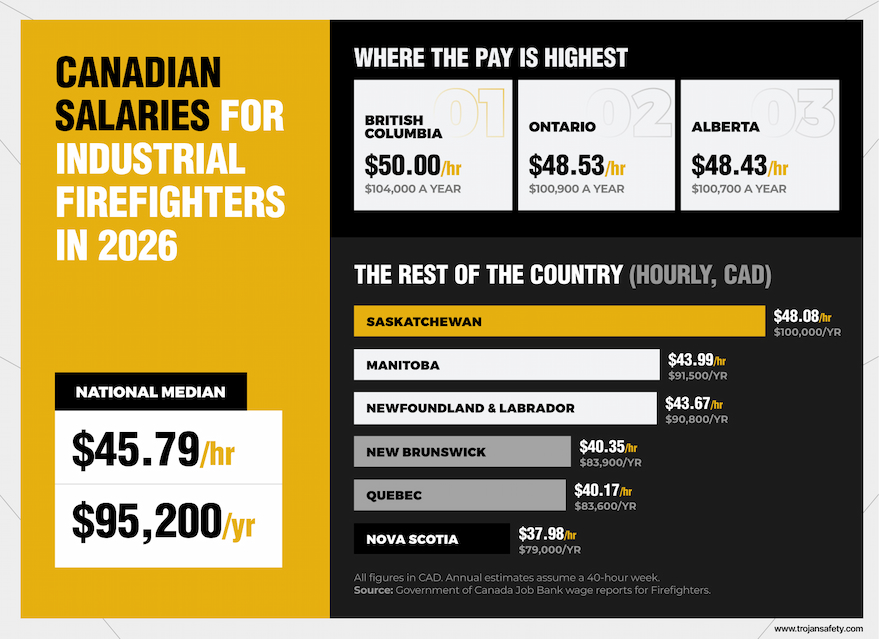
The national median hourly wage for firefighters in Canada is $45.79/hour, which is approximately $95,200 per year (based on a 40-hour work week). The table below compares the median hourly wage and estimated annual salary for the provinces where industrial firefighting opportunities are most common. Data is based on the Government of Canada’s Job Bank wage reports for Firefighters.
| Province | Median Hourly Wage (CAD) | Approx. Annual Salary (CAD) |
| British Columbia | $50.00 | $104,000 |
| Ontario | $48.53 | $100,900 |
| Alberta | $48.43 | $100,700 |
| Saskatchewan | $48.08 | $100,000 |
| Manitoba | $43.99 | $91,500 |
| Newfoundland & Labrador | $43.67 | $90,800 |
| New Brunswick | $40.35 | $83,900 |
| Quebec | $40.17 | $83,600 |
| Nova Scotia | $37.98 | $79,000 |
Pay is highest in BC, Ontario, Alberta, and Saskatchewan, which also have the strongest demand for industrial firefighters.
For industrial-specific roles, Glassdoor reports an average of $100,428 a year, based on 828 self-reported salaries as of February 2026.
What Affects an Industrial Firefighter’s Pay?
The salary of an industrial firefighter can vary significantly depending on the province, employer, and specific job posting. While wages differ across Canada, compensation is generally influenced by several key factors, including work location, industry, experience, certifications, shift schedule, and the level of risk associated with the position.
The following factors have the greatest influence on an industrial firefighter’s earning potential:
- Specialized certifications: Certifications such as H2S Alive, confined space rescue, rope rescue, and HAZMAT response can increase earning potential by qualifying firefighters for more specialized industrial emergency response positions.
- Sector and site type: Industrial firefighters working in the oil and gas, mining, petrochemical, and refinery sectors often earn higher salaries due to the specialized nature of the work, remote locations, and additional job responsibilities.
- Rotational and camp-based work: Rotational schedules at remote sites often offer higher overall compensation, with accommodations, transportation, and other allowances frequently included.
- Overtime and shift premiums: Extended shifts, emergency callouts, and turnaround or shutdown work commonly include overtime and premium pay.
- Years of experience: As firefighters gain experience and advance into senior or supervisory positions, their earning potential generally increases.
Industrial Firefighter Salaries by Experience Level
As industrial firefighters progress through their careers, opportunities for advancement into higher-responsibility positions can significantly impact earning potential. Additional training, specialized qualifications, and movement into senior, lead, or supervisory roles are typically associated with increased compensation.
| Experience Level | Typical Role | Estimated Annual Salary (CAD) |
| Entry Level (0–2 years) | Junior Industrial Firefighter / Emergency Response Technician | $75,000–$95,000 |
| Intermediate (3–7 years) | Industrial Firefighter / Rescue Specialist | $95,000–$120,000 |
| Experienced (8+ years) | Senior Firefighter / Lead Firefighter | $120,000–$145,000 |
| Leadership Roles | Shift Supervisor / Site Emergency Response Lead | $140,000–$180,000+ |
These estimates show how career advancement can create significant differences in earning potential over time, particularly as firefighters move into senior and leadership positions.
Why Industrial Firefighters Choose Trojan Safety for Competitive Salaries
Higher-paying industrial firefighting roles are commonly associated with additional training and certifications that support specialized emergency operations. Qualifications such as H2S Alive, Confined Space Entry & Rescue, Worker Fall Protection, and Detection and Control of Flammable Substances can help candidates access a broader range of industrial positions.
Trojan Safety‘s Fort St. John training facility offers several of these industry-relevant courses, helping firefighters build the qualifications needed to advance their careers in industrial emergency response.
Ready to expand your qualifications and take the next step in your career? Explore training opportunities with Trojan Safety and build the skills needed for industrial firefighting roles.
Frequently Asked Questions
Do industrial firefighters get paid overtime?
It depends on the employer. Alberta’s Employment Standards Code has a special overtime provision for firefighters, but it applies only to firefighters employed by a municipality or a Métis settlement. It specifically excludes firefighters employed by a private company.
Since most industrial firefighter employers are private contractors, industrial firefighters generally fall under the standard overtime rules instead, which require 1.5 times regular pay for hours worked beyond the standard threshold. Day-rate positions may not include any hourly overtime, so it’s worth confirming the pay structure directly with your employer.
What benefits do industrial firefighters typically receive?
Benefits vary by employer, and specific packages are not always publicly listed. Beyond base pay, industrial firefighters should consider whether a position includes extended health coverage, dental benefits, life insurance, retirement savings programs, and other workplace benefits. Benefits can differ from municipal firefighting roles, where public-sector pension plans are often a major part of the overall compensation package. Comparing the full benefits package alongside base pay is an important part of evaluating an offer.
Can you become an industrial firefighter with no experience?
Yes, it is possible to enter industrial firefighting without previous experience, as employers often place greater emphasis on required certifications and training. Related backgrounds, such as volunteer or wildland firefighting, can be beneficial but are often considered assets rather than requirements.
For example, Trojan Safety identifies industrial, oil and gas, and emergency-response experience as an asset for candidates. The most important starting point is typically obtaining the required qualifications, such as NFPA 1001 Level 1 and 2, NFPA 1081, Occupational First Aid, and H2S Alive, before building site-specific experience in the field.
What is the pay structure for industrial firefighters?
Industrial firefighter pay structures vary by employer in Canada. Many industrial roles, especially in oil and gas, are structured as day rates rather than annual salaries, often on rotational schedules such as 14 days on and 14 days off, with camp accommodations and flights covered separately from wages. Other industrial employers structure pay as a standard annual salary or hourly wage instead.
Are industrial firefighter jobs unionized?
Generally, industrial firefighter jobs are not unionized. Unlike municipal firefighters, who are often represented by unions, such as local IAFF chapters, and work under collective agreements, industrial firefighters are typically employed by private companies or contractors with employer-specific pay and employment terms. However, union representation can vary by employer, and some large industrial sites may have unionized emergency response teams.
How does industrial firefighter pay compare to municipal firefighter pay?
Industrial and municipal firefighting follow different employment models, which affects how each is paid. Municipal firefighters are typically hired directly by departments and paid through union-negotiated contracts, while industrial firefighters often work for private contractors on a site or project basis. This difference largely explains the pay gap between the two roles.
Municipal firefighters: $52,000–$84,000/year starting (probationary, varies by city), rising to $110,000–$127,000/year at first-class after three to five years.
Industrial firefighters: roughly $73,000–$87,000/year equivalent starting, rising to $117,000–$149,000+/year for experienced firefighters.