How to Become an Industrial Firefighter
 Written By: Jeff Kirschner, General Manager
 Written By: Jeff Kirschner, General Manager
Industrial firefighters respond to fires, chemical releases, and other emergencies at refineries, plants, and other industrial worksites. They typically serve as trained members of a facility fire brigade rather than a municipal fire department. These specialized brigades are necessary because industrial worksites may contain large volumes of hazardous materials and complex equipment, requiring firefighters to train specifically for the chemicals, systems, hazards, and layout of the facility they protect.
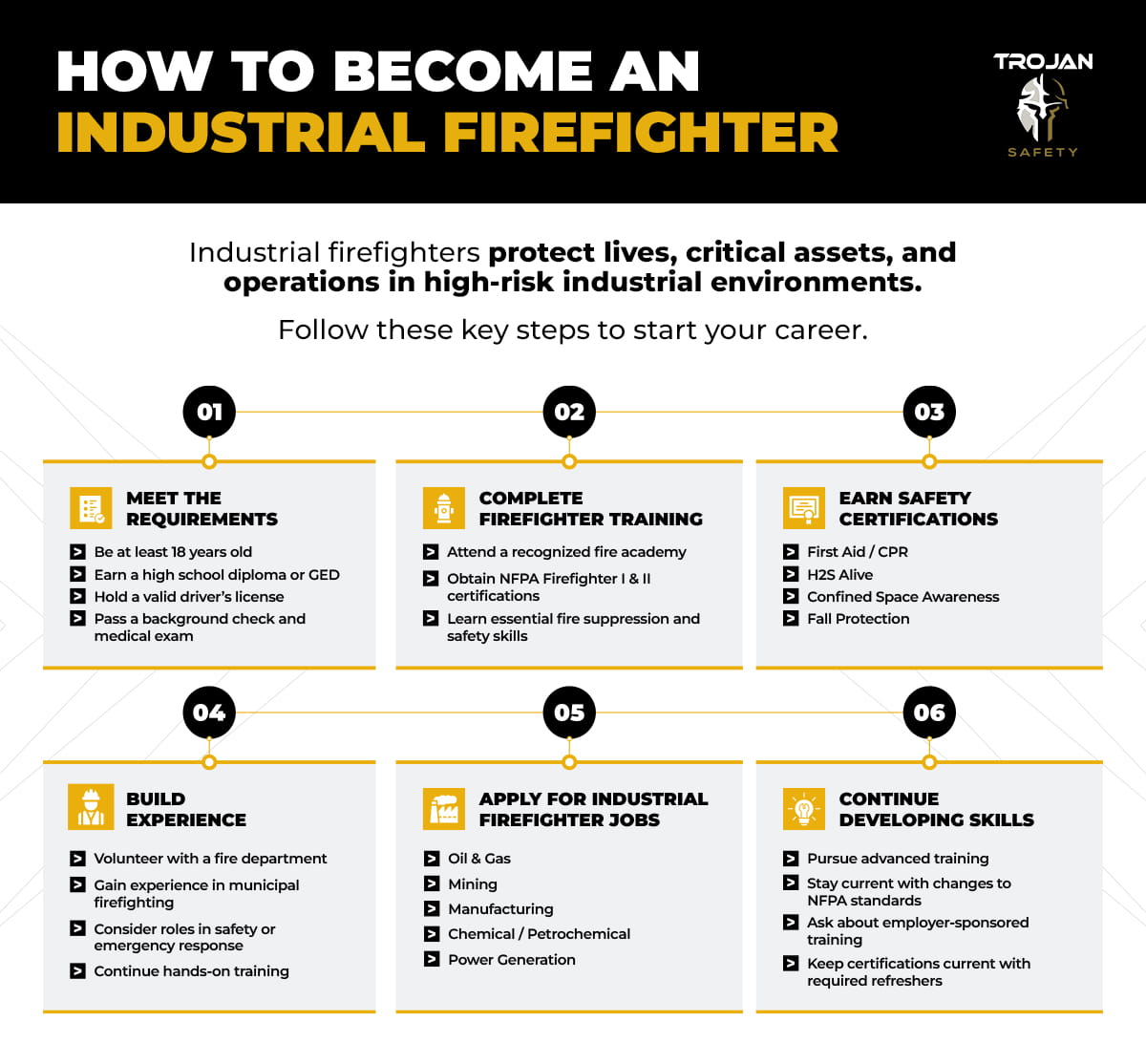
Becoming an industrial firefighter typically means meeting an employer’s physical and driving requirements, earning recognized certifications aligned with standards such as NFPA 1001 or NFPA 1081, and completing additional safety qualifications that can strengthen a candidate’s application. NFPA 1010 is the newer consolidated standard that now contains the Firefighter I and II requirements previously covered by NFPA 1001. However, NFPA 1001 remains widely referenced in Canadian job postings and training programs during the transition to the newer designation.
This guide walks through the steps to become an industrial firefighter, including what the role actually involves, the education and certifications employers look for, and where to get trained in Canada.
An industrial firefighter responds to fires, chemical releases, worker exposures, and other emergencies at refineries, plants, oilfield locations, and other industrial worksites. Rather than responding to emergencies across a municipality, industrial firefighters work as part of an organized emergency response team assigned to a specific facility or job site.
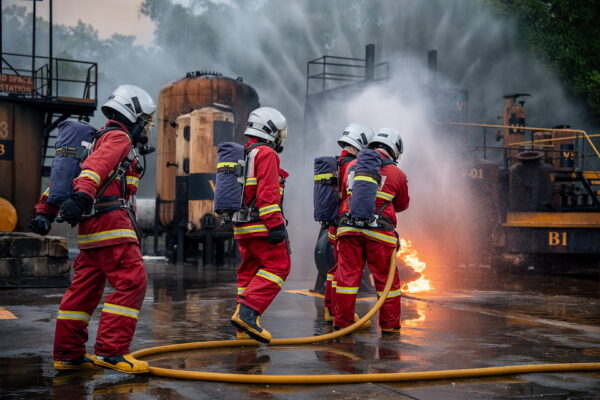
At Trojan Safety, industrial firefighters typically travel in teams of two or three. During a fire response, one team member may operate the pump while another suppresses the fire using foam or water.
Core responsibilities of an industrial firefighter include:
Industrial firefighters differ from municipal firefighters in where they work, what they train for, and how their schedules run:
| Industrial Firefighter | Municipal Firefighter | |
| Where they work | At a specific industrial facility or assigned job site, such as a refinery, plant, mine, or oilfield location | From fire stations serving a city, town, or regional response area |
| Core certification | NFPA 1081 and/or firefighter certification aligned with NFPA 1001 or NFPA 1010, depending on the role and employer | Firefighter I and II certification aligned with NFPA 1001 or NFPA 1010, plus any jurisdiction-specific requirements |
| Site knowledge | Detailed knowledge of the assigned site’s hazards, chemicals, processes, equipment, and emergency response plans | Knowledge of a broader response area containing varied buildings, infrastructure, roads, and community hazards |
| Typical schedule | Project- or rotation-based schedules, often involving consecutive 12-hour shifts; arrangements vary by assignment | Platoon-based shift schedules; the exact rotation varies by fire department |
| Employer | Industrial operators, private emergency-response contractors, or in-house facility brigades | Municipal or regional government |
Requirements for industrial firefighters vary by employer, province, position, and worksite, so it’s best to review current job postings before registering for training. At a minimum, employers commonly look for secondary school completion, a valid driver’s licence and clean driver’s abstract, recognized firefighter training, first aid qualifications, and industry-specific safety certifications.
Trojan Safety, for example, requires its industrial firefighter applicants to hold NFPA 1001 Level I and II and NFPA 1081 certifications, occupational first aid or equivalent training, and H2S Alive. A Class 3 driver’s licence with an air-brake endorsement is preferred. Trojan Safety also states that its firefighters hold training in areas such as Confined Space Entry and Rescue, WHMIS, and Transportation of Dangerous Goods.
A university degree is generally not required, but candidates normally need formal firefighter training and certifications aligned with NFPA 1001 or its successor, NFPA 1010, NFPA 1081, or both, depending on the employer. NFPA 1001 has now been consolidated into NFPA 1010, although many Canadian employers and training providers continue to use the NFPA 1001 designation.
A high school diploma or recognized equivalent is commonly expected for firefighter roles in Canada. Although Trojan Safety does not list a college degree as a requirement for its industrial firefighter position, candidates still need formal firefighter certifications and industry-specific safety training. Requirements vary by employer, and some firefighter positions may prefer or require a college program in fire protection technology, fire science, or a related field.
Beyond formal education and certifications, industrial firefighter employers, such as Trojan Safety, look for:
Industrial firefighter certification requirements vary by employer and worksite. Employers commonly look for firefighter qualifications aligned with one or both of the following standards:
Trojan Safety currently requires applicants for its industrial firefighter role to hold both NFPA 1001 Level I and II and NFPA 1081 qualifications.
Depending on the employer, industry, and hazards present at the worksite, the following qualifications may also be required or may strengthen a candidate’s application:
Trojan Safety offers H2S Alive, Confined Space Entry & Rescue, and Detection and Control of Flammable Substances through its course calendar.
Training availability varies by region, and not every program leads to the same certification. Before enrolling, confirm which NFPA standards the training covers, whether certification is issued through an IFSAC- or Pro Board-accredited agency, and whether the credential is accepted by your target employer. Here is how four Canadian schools and training providers offering industrial or facility fire brigade training compare:
| Training Provider | Province | Relevant Training Offered | Format |
| Suncrest College | Saskatchewan | NFPA 1081: Incipient, Advanced Exterior, Interior Structural, and Brigade Leader | In-person; customized corporate training available |
| Justice Institute of British Columbia | British Columbia | NFPA 1081 industrial fire brigade courses, including Incipient, Advanced Exterior, Interior Structural, and Brigade Leader | In-person; customized contract training available |
| FESTI | Ontario | NFPA 1001 Firefighter I and II, plus hazardous-materials training | 18-week in-house program or blended online and on-site program |
| Lakeland College | Alberta | NFPA 1081: Incipient, Advanced Exterior, Interior Structural, and Brigade Leader | Client-hosted or contracted training; approved facilities and equipment required |
Suncrest College, based in Saskatchewan, offers NFPA 1081 Industrial Fire Brigade training through the Saskatchewan Emergency Response Institute, a partnership between the college and the Saskatchewan Public Safety Agency. Training is available at the Incipient, Advanced Exterior, Interior Structural, and Brigade Leader levels. Successful students receive IFSAC certification issued by the Saskatchewan Public Safety Agency, and training can be tailored to the needs and schedules of industrial employers.
The Justice Institute of British Columbia offers NFPA 1081 training at the Incipient, Advanced Exterior, Interior Structural, and Brigade Leader levels. JIBC states that its NFPA-aligned firefighting courses are accredited by IFSAC and Pro Board and can be delivered on a customized contract basis. Candidates should confirm the current schedule and enrolment format directly with JIBC before applying.
FESTI, located in Ontario, offers an in-house NFPA 1001 Level I and II program that runs for approximately 18 weeks, along with a blended option combining four months of self-paced online theory with 20 days of on-site practical training. The program covers NFPA 1001 Firefighter I and II and hazardous-materials training at the Awareness and Operations levels. After successfully completing the required provincial exams and practical assessments, students receive IFSAC seals and an application for Pro Board seals. FESTI also states that graduates receive internationally recognized accreditation from the Institution of Fire Engineers.
Lakeland College’s Emergency Training Centre in Vermilion, Alberta, offers NFPA 1081 Industrial Fire Brigade training at the Incipient, Advanced Exterior, Interior Structural, and Brigade Leader levels. It also provides corporate training that can be customized with site-specific components for an employer’s fire brigade.
Once you know which qualifications you need, the next step is to find an appropriate program in your region and confirm that its credentials will be accepted by your target employer. Here is how to narrow down your options:
Trojan Safety has provided industrial safety and emergency-response services across Western Canada’s oil and gas, mining, pulp and paper, forestry, and construction sectors since 1994. Its industrial fire services are supported by modern fire and shower units equipped for fire suppression, worker decontamination, and emergency response at remote and high-risk worksites.
Trojan Safety recruits industrial firefighters for work in British Columbia and Alberta and provides opportunities to gain hands-on emergency-response experience while building a longer-term career in industrial fire and safety. Current opportunities are listed on Trojan Safety’s careers page.
Candidates who need to strengthen their qualifications can also register for courses such as H2S Alive, Confined Space Entry & Rescue, and Detection and Control of Flammable Substances through Trojan Safety’s course calendar.
The time it takes to become an industrial firefighter depends on the qualifications required by your target employer and the training path you choose. An individual NFPA 1081 facility fire brigade course may take considerably less time than a comprehensive Firefighter I and II program, but course lengths vary by provider and certification level.
For example, FESTI’s in-house NFPA 1001 Level I and II program runs for 18 weeks, or 85 training days. Its blended program combines four months of self-paced online theory with 20 days of on-site practical training.
Completing firefighter training does not automatically make a candidate eligible for every industrial position. Employers may also require NFPA 1081 certification, first aid, H2S Alive, an appropriate driver’s licence, a clean driver’s abstract, and other worksite-specific qualifications. Once those requirements are met, the time needed to secure a position depends on current job openings and the employer’s hiring process. Trojan Safety, for example, accepts applications directly from candidates who already meet its listed qualifications.
Not usually. An EMT or paramedic certification is not a universal entry requirement for industrial firefighter roles. However, employers often require some form of emergency medical training, such as occupational first aid and CPR. Trojan Safety, for example, requires Occupational First Aid or an equivalent qualification for its industrial firefighter positions.
More advanced credentials, such as Emergency Medical Responder or Primary Care Paramedic certification, can strengthen a candidate’s qualifications and create opportunities to work in combined fire-and-medical response roles.
HAZWOPER, or Hazardous Waste Operations and Emergency Response, is a US OSHA standard that establishes training and safety requirements for certain hazardous-waste operations and emergency responses involving hazardous substances.
HAZWOPER training is not normally required for industrial firefighters working solely in Canada because it is a US regulatory standard. Canadian employers generally require qualifications based on provincial safety regulations and the hazards present at the worksite. These may include WHMIS, hazardous-materials response training, and firefighter certifications aligned with NFPA 1010, NFPA 1081, or NFPA 470.
Canadian candidates may still encounter HAZWOPER in US job postings or when applying for cross-border work, so it is important to check the requirements of the specific employer.
Pay varies by region and employer. Glassdoor reports an average salary of $100,428 CAD per year (about $48/hour) for industrial firefighters in Canada, with a typical range between $73,013 and $149,416 depending on experience and location. Alberta postings for entry-level rotational roles have listed hourly wages in the $23 to $25 range, which typically climbs with experience and certification level.
Not always. A university degree is generally not required, and some industrial employers accept candidates with a high school diploma or recognized equivalent, provided they hold the required firefighter and worksite-safety certifications. Trojan Safety, for example, requires NFPA 1001 Level I and II, NFPA 1081, occupational first aid or equivalent, and H2S training, but does not list a college credential.